Showing posts with label lessons. Show all posts

Saturday, June 15, 2013

Getting Dizzy

So as I mentioned earlier, I went out to try reining today on the southern peninsula of Maryland (AKA the middle of nowhere). It was a lot of fun! Not necessarily a style of riding I'd want to do on a regular basis (not a fan of the plod-along trot or the herky-jerky canter), but it was fun to try and the horses were VERY well schooled at this farm.

Essentially the difference appears to be that to steer in a curb bit, you lift your hand, put one leg on, and take the other leg completely off the horse so you are pushing him into an empty space. Then you drop your hand again once the horse starts going in the direction you want.

Of course Lena, the lesson horse mare I was riding, quickly figured out how green I was to all of this and took it upon herself to help me practice this new kind of steering by ducking in, stopping at the gate, and cutting corners -_- I guess that is why she is a lesson pony!

I had a lot of trouble getting the correct canter lead since they have been trained to canter from a squeeze with two legs, rather than bending to the inside and then asking with the outside leg. She was grumpy in general and since I had been fumbling with the new style of steering, she was ducking in especially as we attempted the canter

But that wasn't really the main event...at the end of my lesson, I got to try some spins on a horse with the special sliding shoes.

I also got to wear some cowboy spurs. Don't worry, they weren't sharp--the rowels are more for show than anything. Starlight responded to just a tickle from them.
 Yeehaw!

Don't worry, I won't be turning to the dark side more than occasionally...this reining farm is 1.5 hours away from me. And I love my boy's big trot and his valiant effort at jumping!

Wednesday, July 11, 2012

Dressage lesson!!!

After carefully budgeting my entry-level salary using mint.com (no, they're not paying me to say that--I just have found it super useful), I've decided that I can afford to take one riding lesson per month. Not ideal, but I do have access to horses I can ride to practice what I learn. Instead of my usual hunter-jumper lessons, I decided to go with a dressage instructor. I'm hoping to go back to basics in a systematic way, and I think dressage is the way to go for that.

Anyway, now I am SUPER excited. It just reminds me yet again of my horse addiction. I find myself daydreaming about the lesson and the whole reason I'm even writing this post is that I need to stop annoying my very patient boyfriend by talking about how this is a great way for me to meet more horse people in the area and people to ride with and maybe even find a good boarding barn for later on and unlock Joey's Dressage Pony secrets because he just nods, smiles, and says, "That sounds great, babe!" because he has no idea what I'm going on about.  I've Google mapped the way to this new barn from my house and from work; I've checked out deals on new breeches online; and I've gotten giddy at an excuse to make my boots shiny-clean before each lesson (don't ask me why; I just find it's soothing and it makes me feel like the real deal). Can you tell I'm looking forward to this?

My riding education thus far has been kind of piecemeal--I have had some great instructors, but I've never worked together with an instructor to really further my "riding education." The instructor I was with the longest (from age 13-18) unfortunately didn't explain much, and as I realized later, was not the most humane to his horses. This  instructor has a good reputation of teaching people about the whys behind dressage so I'm hoping that will translate into me gaining a better foundation that I can build upon in my (slow) path to buying or leasing my first horse.

Also, I'm doing a low-level H/J show this fall. I've done this series several times before, and I intend to kick ass again...just putting it out there in Internet-land just so that dozens of strangers will peer-pressure me into writing a post about my show. The horse I will be riding is kind of far away from where I live now so I need that extra motivation to actually make it out there for some practice rides this summer. I'm hoping that dressage lessons will ramp up my jumping classes an extra notch. It's a schooling show (they mix English and Western in the same class if that tells you how casual it is), but I could still stand to use it as a test of my skills. As a previous instructor told me, I just need to think of the jumping classes as dressage with obstacles, not "stop breathing and tear around the course as fast as possible!" classes.

:)! 

Sunday, June 17, 2012

Lesson plan: walk, trot, beginning canter

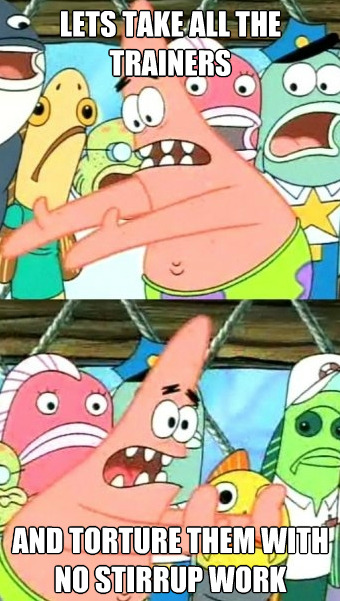
What about: Let's take all the students and pass on the no-stirrups work our trainers inflicted on us to the next generation? Not as catchy. via
Teehee.
So the first two lessons I taught today were 30-minute private lessons.

The first was for a re-rider who began riding at age 4, but took a long hiatus and now has some confidence issues, especially when her horse's attention starts to wander. She has just started to canter again on a big Percheron mare named Bella.

That lesson went very well so I taught another before heading home for some Father's Day celebration. This student was a teenager who also lessons at another farm. She has just started to canter regularly as well with a sporty Percheron/TB named Levi. I adapted the below lesson plan for both of these riders, so I just included everything that came up as an issue.

Setup: Four cones in a diamond shape at one end of the ring for teaching precise circles.

Walk:
  • Forward: Start with a nice, swingy walk. Feel the movement in your seat and alternate inside and outside leg pressure with the swinging of the horse's barrel.
  • Calm: Follow with seat and hands.
  • Straight: Pretend your hips have laser beams coming out of them (it sounds weird but that is how I like to think of it). Keep them straight and look ahead. If your horse tries to cut in, correct her with inside leg and opening inside rein. If that doesn't work, strengthen the inside leg and inside rein (without dropping the outside rein) until it does, then release and continue with your hips straight.
  • Two-point for one lap: Don't worry about looking like a jumper with your upper body. Feel your heels sink down and your calves connect with your horse's sides. This is the leg position to strive for. If you find your leg swinging, a little bit of  (correct) two-point will help to stabilize it.
  • Bend in corners: Inside leg, opening inside rein, supporting outside rein. Keep the swingy, forward, following walk on the straightaway.
  • Circles: Ride a straight line from one cone to the next, and bend around each cone (inside leg, opening rein, then outside leg to straighten again to the next cone).
Trot:
  • Straight
  • Bend in corners
  • Change direction across the ring
  • Sit the trot without stirrups (Did this for the second rider. Levi kept cutting in at the canter and she felt that her leg just wasn't there to move him over. Believe me...I can emphathize)
  •  Circles: (same as above)
Canter:
  • Canter setup: Sit the trot. Inside leg, opening rein, outside leg.  Both horses cut in/were lazy so I told the students to look forward, keep their hips straight, and sort of swivel with an inside rein and leg combination. We were moderately successful but I am sure better straightness and obedience (from the horses. The students were very obedient.) will come with practice.

Feel free to critique or make suggestions! It's only going to help.

Monday, April 30, 2012

Riding at the University of Maryland

You may remember that I'm a Terp, albeit a not-terribly-school-spirited one.
I would much rather spend my time making cute food rather than going to a game. I didn't make this though; Snarky Rider shared it on FB
 A big part of why I chose to come to Maryland was the on-campus riding club. I was only a member for one semester, since I found it rather fishy that four out of their eight horses were lame. I also really didn't like that we only had two horses allotted to our lesson of four girls so we had to switch in the middle of the lesson.

However, I thought it would be fair and useful to see the other side. I haven't been around the campus farm for three and a half years, and I didn't want to show badly enough to warrant the IHSA team dues. I interviewed Leandra Bitterfeld, a student instructor for the University of Maryland Equestrian Club and treasurer of the IHSA team to get some perspective on which riders are best suited to club versus team riding.

Overall: Club versus Team 

via
“The club is where you want to go if you want to learn about horses,” Leandra explains. The Equestrian Club has a barn on the University of Maryland’s 1250-acre campus. Though they do show once a year on Maryland Day, the yearly campus-wide open house, the club is a non-competitive organization focused on horse care, management, and riding. 

“Maryland is the only student-run equestrian club in the country,” says Leandra, which means that all club members pitch in. In addition to attending monthly meetings and a weekly lesson (if they choose to ride), members must do one chore per week, whether it’s haying, feeding, or mucking stalls. The lesson horses play double duty too—they are also used for equine labs in the Animal Science department. Only about half of the students in the club ride, since many are simply interested in gaining experience with horses.

The club also offers students the opportunity to learn to teach. Leandra took two tests and did an evaluation ride to become an instructor for the club’s A lesson group (the club groups members based on ability—A being advanced and E being beginner riders). She has found teaching to be just as educational for her as it is for her students: “Every time I go into the ring I’m learning so much about my riding. When I’m watching these girls make mistakes, I’m also learning so much for myself. And that’s been my favorite part of teaching—being able to share my knowledge and take so much knowledge back from it.”

via
As you would expect, the IHSA team is more focused on competition than the club. According to Leandra, the average club member is just learning to canter, while the average team member is jumping 2’ or 2’6”.  Since the team mostly attracts people who already have horse experience, they require members to at least know how to walk and trot. “The level that we’re taught at is more specialized,” Leandra says, nothing that there are rarely enough dead beginners interested to fill up a group lesson.

Since IHSA riders are not familiar with their host school’s horses, the focus is on rider performance. Potential IHSA members should not stress about the possibility of a host school horse acting up because riders have the opportunity to ask for a “re-ride” which allows them to try again on a different horse. However, this is the exception rather than the norm. Leandra says, “I’ve gotten to ride so many amazing horses that I could never afford, especially as a college student.”
The UM Equestrian Team rocks the sweatpants-over-breeches look on a cold show day! I can empathize.
photo credit: Leandra Bitterfeld/ UMET FB


Finances
  • The club is financed by the Student Government, Campus Recreation Services,  member fundraising, and dues. Riding members' dues are $225 per semester and non-riding members' dues are $25 per semester. Definitely WAY cheaper than 11 weeks of lessons, which could cost anywhere from $440-660 in the DC metro area.
  • The team is completely financed by its members, who pay $500 per semester to cover the use of Oatlands Stables horses in lessons and shows, IHSA fees, tack, and transportation. Members who do not have show clothes borrow from other members. “We borrow and trade and swap all the time,” says Leandra, who sometimes finds herself lending out her show helmet to two or three riders who only have plastic schooling helmets in one day.
Time
  • The team is more of a time commitment than the on-campus club, since weekly lessons at Oatland Stables are 45 minutes from campus (when it's not rush hour--DC traffic is no joke) and the team attends eight to nine shows per year, sometimes staying overnight for two-day shows. The team also has occasional meetings. However, so much time spent with teammates and riders from other schools only adds to the sense of camaraderie and friendship. “The sportsmanship in the region is really strong,” says Leandra. 
  • For the club it depends on the chore you have. All members are required to do one barn chore (feeding, mucking, haying, etc.) which could take anywhere from an hour to several hours, and some members also choose to ride in an hour lesson (meaning about two hours to allow for walk time on our large campus plus tacking up).
Hopefully that was useful for any of you who are trying to decide where to go to college. There are so many different incarnations of IHSA teams and clubs that comparing different schools is daunting, so I hope that my stab at it was useful--I hope it showed that just because one person had a negative experience doesn't mean that everyone does. In hindsight, I don't think I was suited to the club from the start--I was raring to continue jumping 2'6" as I was accustomed to in my high school lessons, and I was really disappointed that my group was only doing cross rails and cavalletti to keep the horses sound. I'm only just beginning to understand the gaps in my flatwork that I didn't know enough to recognize back then.

There are many other resources available to compare schools which I covered in another post. Let me know if you've ever ridden for another school's IHSA team--I'd be happy to interview you for the greater good of high school seniors :)

Monday, April 23, 2012

Making the most of lessons...trying, at least

So for my 22nd birthday this past March, my mother was kind enough to gift me with four riding lessons with the trainer I've been working with for the past six months. I spent the first lesson riding Stan, who is a bit of a Frankenhorse, and very spooky, but never genuinely does anything bad (although apparently I am the only person he is spooky for--which just makes me feel great). Since I do not take lessons very often, I think I put a lot of pressure on myself to get my money's worth and it just adds to my tension when I don't do what I'm supposed to, either from fear or muscle memory, or both (for example, acting as if Stan is ALWAYS going to freak out in the scary corner of the ring).

Just because he is a Frankenhorse with a parrot mouth, crooked legs, and a roached back...

...doesn't mean he isn't handsome! This is why we call him Manly Stanley!

I love riding Stan because once we work through the spooky stuff, he is very responsive. However, I do want to make the most of my lessons and challenge myself so that I can actually grow.

Clyde is the first horse I rode at this trainer's farm until he threw me and then was lame for several weeks (related incidents, but I can't remember exactly what the injury was). He is ridiculously finicky about his canter transitions, and WILL NOT canter unless you:
  1. Sit deep and half-halt,
  2. switch your weight to the inside and bend with the inside leg and rein,
  3. then put on the outside leg at the EXACT RIGHT MOMENT of his stride. I am not good at this. At all. So he usually just ends up strung out in a super-fast trot and I usually end up out of breath from clucking and all hunched up from trying to do too many things at once.
Clyde says, "Check out my tattoo!"
So what with Clyde's being lame, Stan being an easier ride, and not having money for lessons until recently, I haven't ridden Clyde for several months. I have been reading the fantastically useful Build a Better Athlete!: 16 Gymnastic Exercises by Leslie Webb, though, and Webb recommends cueing for the canter (step 3 from above) by swinging your lower leg slightly behind the girth and sort of brushing the horse's side with your calf instead of squeezing. I've been doing that with Joey, who tends to rush into the canter and he responds immediately to it--maybe because he is a dressage pony and I guess they tend to do more swinging around with the lower leg for various cues.

Long story short--I wanted to ride Clyde for my lesson so I could try this magical new canter cue. In my first lesson, I went in totally confident and I was able to regain control and calmness after Stan spooked once at the Evil Demon Corner. I was feeling good, ready for a challenge. Even if Clyde didn't respond, at least I would get some practice feeling when the exact right moment of his stride would be to ask.

I didn't count on my trainer saying, "We'll probably just keep it to a walk and trot since you haven't ridden him for a while," immediately when I mounted up. I was disappointed, but I realized that Rome wasn't built in a day, and that maybe I could use my other lessons to work on cantering with Clyde.

Another thing I didn't count on was the wind.

And the fact that the wind would blow the jump filler flowers, making them look like they were up to no good.

Or that Clyde sees dead people in the bushes. Or something. I didn't see what it was that made him decide to suddenly turn tail along the straightaway, since I was concentrating on, "Forward. Straight. Straight, straight, straight," and looking forward rather than at Clyde. What I do know is that once we got about 15 feet away from the corner, I was hanging on his neck and wondering how I got there. There was no chance of me salvaging the situation since Clyde was still skittering away from the dead people in the bushes, so I just slid on down and landed on my butt, thanking my trainer for redoing her ring a couple months ago with wonderfully soft, even footing.
Clyde plots his next scheme.
 I hadn't even seen it coming, but that was it for me. After I mounted back up, my leg muscles were trembling from the shock of it, just like they do every time I fall, and I was frustrated that I couldn't make them stop. My trainer said to just hang out at the halt and take a few deep breaths. This just gave me more time to think about what a disappointment the lesson had turned out to be. No cantering, then I fell off at the trot, and now I couldn't stop my trembling body from telling Clyde, "Yes. Continue to freak out. Everything is scary today."

We picked up a walk, then a trot, on the other end of the ring, but of course that's where the suspicious jump filler was, so our circles were shaped more like kidney beans (sadly, not an exaggeration). Now it seems silly, but I was so disappointed in the difficulty I was having in just making a simple circle that I started tearing up when I asked my instructor what I was doing wrong. When the lesson was over, I seriously wondered whether I should even be riding horses like hers. What had I even learned? I felt that by asking me to retreat to the other side of the ring, my instructor was letting me back down from the problem instead of facing it. Maybe she thought that I wasn't capable of facing it. And maybe I wasn't.

In hindsight, she was crunched for time and probably just needed to wrap things up, but it was still a pretty confidence-crushing lesson for me. I mean, my entire blog is about me identifying as someone who rides whenever/whatever she can, and I fell off at the trot.

This past week, my instructor and I had more time to talk. I asked her whether she thought I should be riding school horses instead of her show horses, and she said that at a certain level, you just have to work through problems like the ones that Stan and Clyde tend to throw at me. And that's true. While I enjoy riding push-button ponies like Joey, I don't really have much to learn from a horse that does anything I ask.

For the rest of the lesson, we worked on my sitting trot and my canter departs, since that pre-canter running trot is where everything falls apart. It was never a problem with the drafts I've been riding through most of college since they are so comfy, but now I'm glad that I'm working on the things that will actually give me a good return on my investment.

Moral: Buck up and look forward to the next lesson, whenever that may be!